
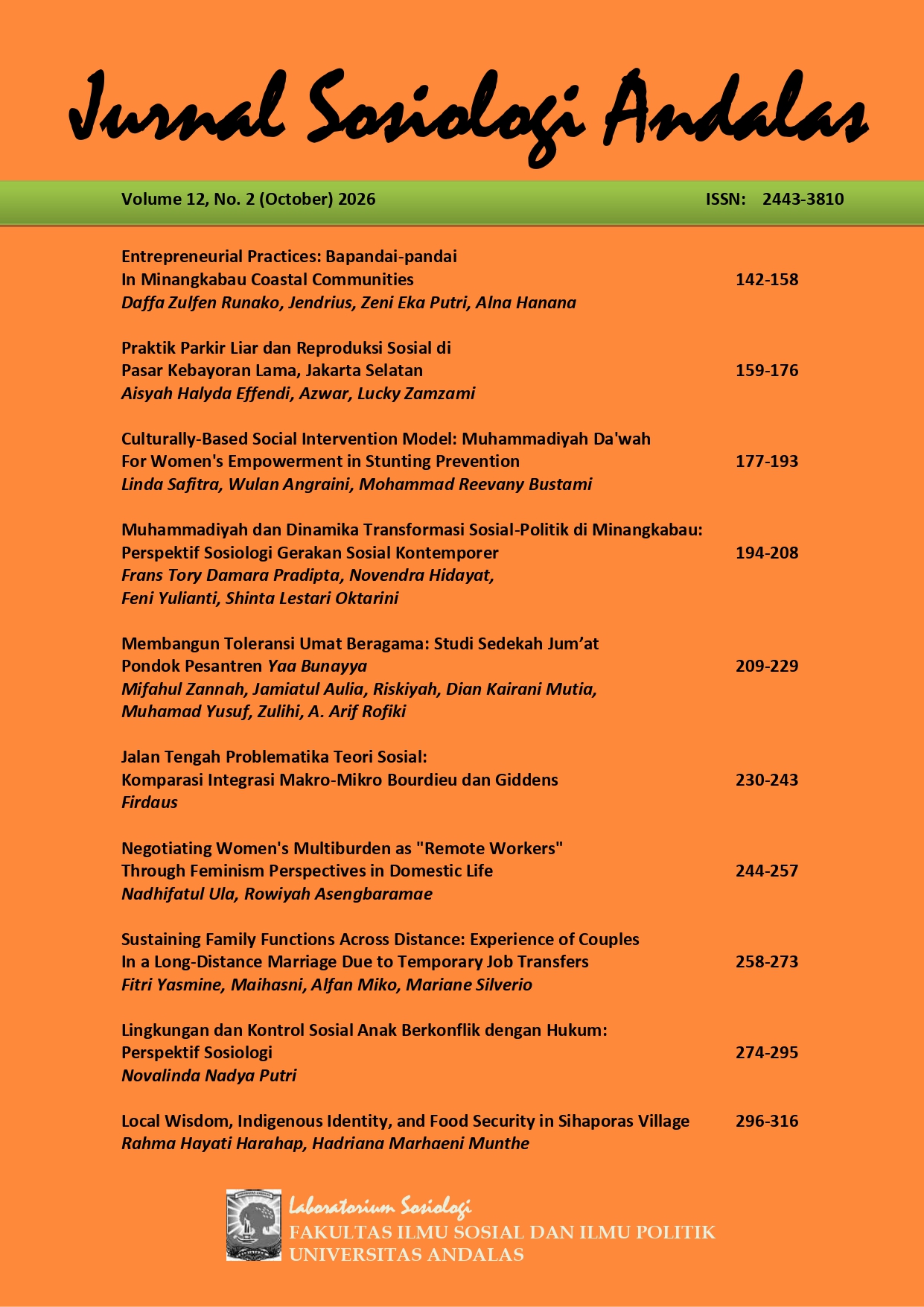
Praktik Parkir Liar dan Reproduksi Sosial di Pasar Kebayoran Lama, Jakarta Selatan
DOI:
https://doi.org/10.25077/jsa.12.2.159-176.2026Keywords:
Policy, Practice, Illegal Parking, Parking Attendants, Community OrganizationAbstract
Kebayoran Lama Market in South Jakarta has a high volume of visitors, which is not supported by adequate formal parking facilities. This condition has encouraged the emergence of illegal parking practices involving the mass organization Pemuda Pancasila in its management. Previous studies generally focused on conflicts, public perceptions, and the control of illegal parking by certain individuals. This study focuses on the involvement of mass organizations as the main actors in illegal parking practices and their relation to informal power relations and the control of public space in urban areas. This study aims to analyze the roles and involvement of illegal parking attendants affiliated with Pemuda Pancasila in managing and maintaining illegal parking practices in Kebayoran Lama Market. This research employs Anthony Giddens’ Structuration Theory using a qualitative method with a case study design. Data were collected tusing observation, in-depth interviews, and document collection.The findings show that illegal parking practices operate through the division of parking areas, worker selection, shift arrangements, and deposit mechanisms controlled by “pioneers” who hold authority over each illegal parking area in Kebayoran Lama Market. Pemuda Pancasila also plays a role in building informal networks with influential actors through deposit mechanisms, enabling illegal parking practices to persist. This study demonstrates that illegal parking practices are not merely caused by limited parking facilities, but also reflect informal power relations, the control of public space, and the reproduction of structures through interactions between agents and structures in urban spaces.
References
Afrizal. (2014). Metode Penelitian Kualitatif Sebuah Upaya Mendukung Penggunaan Penelitian Kualitatif Dalam Berbagai Disiplin Ilmu. PT Rajagrafindo Persada.
Amril, I., Abbas, A., & Prahara, S. (2014). Konflik Pengelolaan Parkir Liar Di Pantai Purus, Kec. Padang Barat, Kota Padang. Jurnal Ilmu Sosial Mamangan, 3(1), 40–48. https://doi.org/10.22202/mamangan.v3i1.1351.
Badan Pusat Statistik Provinsi DKI Jakarta. (2024). Statistik Transportasi Provinsi DKI Jakarta 2024.
Badaru, B., & Begishev, I. (2024). The Criminal Law Enforcement Based on Socio-Legal Approach Against Illegal Parking Officers in Achieving Justice. Jurnal IUS Kajian Hukum Dan Keadilan, 12. https://doi.org/10.29303/ius.v12i2.1420.
Dovey, K., & Recio, R. B. (2024). Inventraset Assemblages: The spatial logic of informal street vending, transport and Settlement. Urban Studies, 61(12), 2265–2289. https://doi.org/10.1177/00420980231223060.
Fachrina, Pramono, W., & Hanandini, D. (2021). Pengantar Metode Penelitian Sosial. Andalas University Press.
Giddens, A. (2010). TEORI STRUKTURASI, Dasar-Dasar Pembentukan Struktur Sosial Masyarakat. Pustaka Pelajar.
Gratama, R. A., & Waspada, A. E. B. (2014). Kampanye Pencegahan Parkir Kendaraan Bermotor Pada Tempat Yang Tidak Tepat di Kota Bandung. Jurnal Tingkat Sarjana Bidang Senirupa Dan Desain. https://media.neliti.com/media/publications/180595-ID-kampanye-pencegahan-parkir-kendaraan-ber.pdf.
Hidayatulloh, M. R. (2023). Penerapan Sanksi Pidana Terhadap Pungutan Liar Oleh Penyelenggara Parkir Ilegal. JURNAL LEGISIA, 15(1), 36–49. https://doi.org/10.58350/leg.v15i1.250.
Igudia, E., Ackrill, R., & Machokoto, M. (2022). Institutional Incongruence, The Everyday, and The Persistence of Street Vending in Lagos: a demand-side perspective. Environment and Planning A, 54(6), 1256–1276. https://doi.org/10.1177/0308518X221083989.
J.O, I., M.A, A., & K.O, A. (2021). Abuse of Parking Facilities and the Decay of Ikeja Central Business District, Ikeja Local Government Area, Lagos State. Journal of Veterinary and Biomedical Sciences, 7(2). https://doi.org/10.36108/laujoces/1202.70.0270.
Kusambarto, A. (2025). Penyelenggaraan Perparkiran di Provinsi DKI Jakarta.
Luthfia, A. R. (2016). Kuasa Aktor Dalam “DUNIA” Parkir Liar (Studi Kasus Kuasa Aktor Dalam ‘Dunia’ Parkir Liar di Sekitar RSUP Dr. Sardjito dengan menggunakan Perspektif Foucauldian dan Gramscian). Jurnal Penelitian Sosial, 4(1). https://ejournal.uksw.edu/cakrawala/article/view/54.
Nasyar, N. M., Harsasto, P., & Adnan, M. (2016). Analysis Problematics Of Illegal Parking In Tanah Abang Market Central Jakarta. Journal Of Politic and Government Studies, 5. https://ejournal3.undip.ac.id/index.php/jpgs/article/download/10906/10581.
Peraturan Daerah Provinsi Daerah Khusus Ibukota Jakarta Nomor 5 Tahun 2014 (2014).
Peraturan Daerah Provinsi DKI Jakarta Nomor 1 Tahun 2024. (2024).
Peraturan Gubernur DKI Jakarta Nomor 188 Tahun 2016. (2016).
Peraturan Pemerintah Republik Indonesia Nomor 80 Tahun 2012. (2012).
Prabowo, I. H., Nugrahaningsih, W., & Aryono. (2025). Penegakan Hukum terhadap Parkir Liar di Kota Surakarta. Hukum Inovatif: Jurnal Ilmu Hukum Sosial Dan Humaniora, (3). https://doi.org/10.62383/humif.v2i3.1896.
Priyono, H. (2002). Anthony Giddens Suatu Pengantar. Kepustakaan Populer Gramedia.
Ramadhani, R., & Nusanto, B. (2026). Antara Layanan Publik dan Premanisme: Perilaku Juru Parkir di Jalanan Sibuk Jember. Jurnal Sosiologi Andalas, 12(1). https://doi.org/10.25077/jsa.12.1.106-125.2026.
Safitri, A., Sulaksono, T. P., Aziz, M. A. A., & Dewantara, M. B. (2025). Persepsi Masyarakat Terhadap Keberadaan Juru Parkir Liar di Kota Bandar Lampung. Jurnal Kajian Hukum Dan Kebijakan Publik, 2(4), 995–004. https://doi.org/10.62379/ga3b6049.
Saputra, R. F. (2022, December 7). Parkir Liar yang Menyebabkan Kemacetan. Kompasiana.Com. https://www.kompasiana.com/rizqy46220/639030334addee650249faf2/parkir-liar-yang-menyebabkan-kemacetan.
Sitanggang, R., & Saribanon, E. (2018). Faktor-Faktor Penyebab Kemacetan Di DKI Jakarta. Jurnal Manajemen Bisnis Transportasi dan Logistik, 4(3), 289–296. https://doi.org/10.54324/j.mbtl.v4i3.823.
Sitorus, A. M. H. (2022). Sistem Transportasi Terintegrasi di DKI Jakarta: Analisis Transformasi Berkeadilan Sosial. Jurnal Sosiologi Andalas, 8(1), 31-41. https://doi.org/10.25077/jsa.8.1.31-41.2022.
Soge, A. V. (2019). Persepsi Masyarakat Tentang Keberadaan Juru Parkir Liar Di Pasar Segiri dan Samarinda Square Kecamatan Samarinda Ulu. EJournal Sosiatri-Sosiologi, 2019(1), 103–115. https://ejournal.ps.fisip-unmul.ac.id/site/wp-content/uploads/2019/01/01_format_artikel_ejournal_mulai_hlm_Ganjil%20(01-29-19-01-31-21).pdf.
Undang-Undang Lalu Lintas dan Angkutan Jalan (UULAJ Nomor 22 Tahun 2009). (2009).
Venti, C., Sholva, Y., & Dwi Nyoto, R. (2020). Sistem Manajemen Parkir Mobil On Street dan Off Street Berbasis Location Based Service (LBS) dan Google Maps API. JUSTIN (Jurnal Sistem dan Teknologi Informasi), 8(1), 48-57. https://doi.org/10.26418/justin.v8i1.35789.
Wulandari, S. (2015). Pengelolaan Parkir Tepi jalan Oleh UPTD Pengelola Parkir Pada Dinas Perhubungan Di Kota Samarinda. EJournal Administrasi Negara, 3(1), 35–46. https://ejournal.ap.fisip-unmul.ac.id/site/wp-content/uploads/2015/02/Jurnal%20Septiani%20Wulandari%20(02-20-15-03-32-22).pdf.
Downloads
Published
How to Cite
Issue
Section
License
Copyright (c) 2026 Aisyah Halyda Effendi, Azwar Azwar, Lucky Zamzami

This work is licensed under a Creative Commons Attribution-NonCommercial-ShareAlike 4.0 International License.