
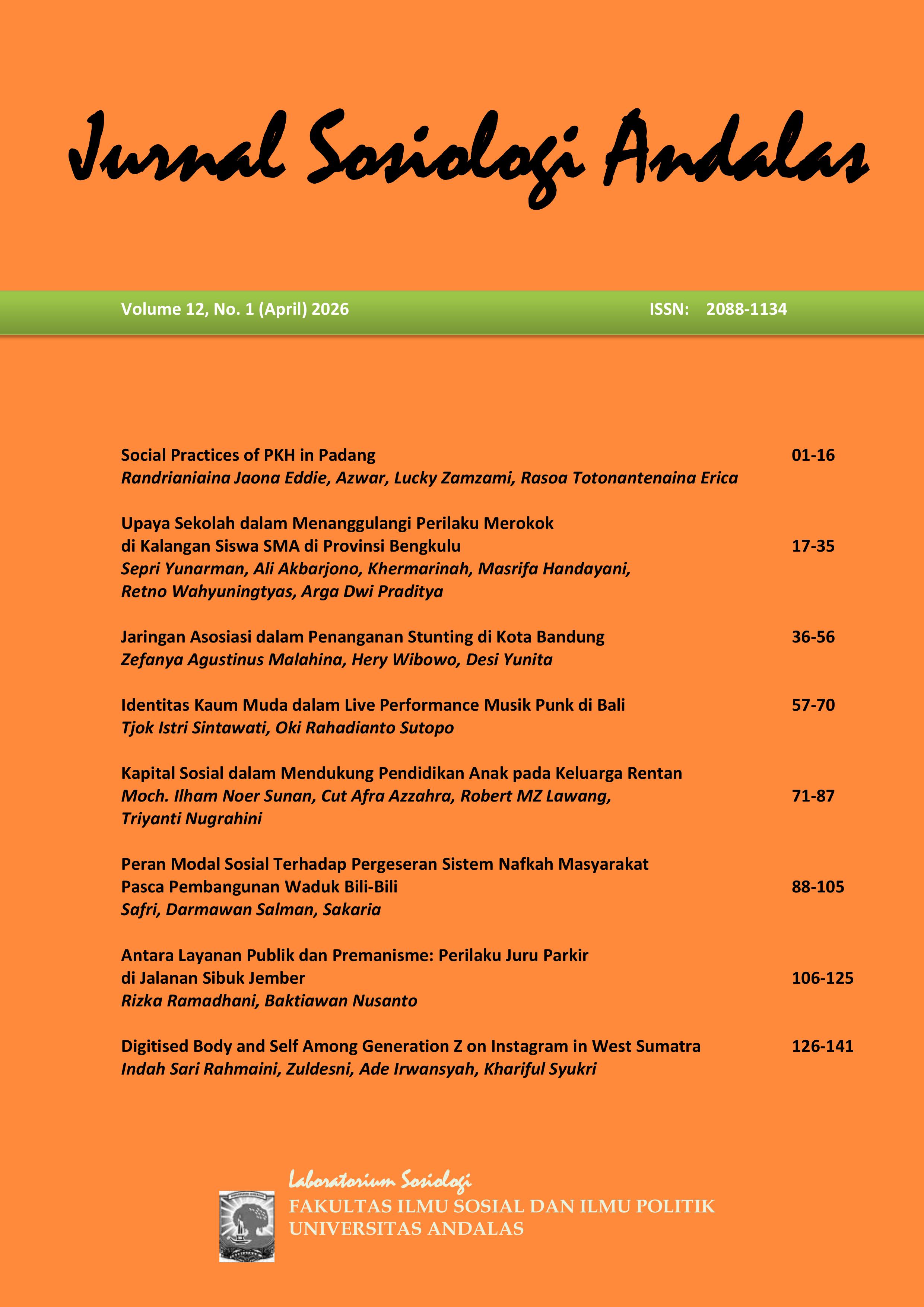
Digitised Body and Self Among Generation Z on Instagram in West Sumatra
DOI:
https://doi.org/10.25077/jsa.12.1.126-141.2026Keywords:
Generation Z, Instagram, Digitised Body and SelfAbstract
This study aims to determine how the Digitized body/self is perceived by Gen Z on Instagram and explore the challenges faced by Generation Z in constructing and producing digital identities in their daily activities. This study uses a digital sociology perspective and Deborah Lupton's concept of the digitized body in the context of the West Sumatra community. This study uses a qualitative approach using netnographic research types such as observation of visual content, captions, profile descriptions, and interaction patterns that complement the explanation of their digital practices. This research is complemented by in-depth interviews with Instagram users from Generation Z based on predetermined criteria. The results show that Generation Z forms the digitalization of the body and self through the practice of audience segmentation based on goals, namely using multiple accounts, using anonymous accounts, selecting posts based on audience groups per account, and differentiating the digital self they want to show based on the account's purpose. This form of digitalization reflects the difference between online representation and their real-world self.
References
Aboim, S., & Vasconcelos, P. (2013). From Political to Social Generations. In European Journal of Social Theory. https://doi.org/10.1177/1368431013509681.
Anand, N., & Brass, I. (2021). Responsible Innovation for Digital Identity Systems. Data & Policy. https://doi.org/10.1017/dap.2021.35.
Baird, R. (2022). Youth and Social Media: The Affordances and Challenges of Online Graffiti Practice. In Media Culture & Society. https://doi.org/10.1177/01634437211069969.
Bencsik, A., Csikos, G., & Juhaz, T. (2016). Y and Z Generations at Workplaces. Journal of Competitiveness, 90(106), 90–106.
Bessant, J., Farthing, R., & Watts, R. (2017). The precarious generation: A political economy of young people. taylorfrancis.com. https://doi.org/10.4324/9781315644493.
Brison, S. J. (2023). Aftermath: Violence and the Remaking of a Self. degruyter.com. https://doi.org/10.1515/9780691245744.
Butkowski, C., Bimo, S., & Bhandari, A. (2023). Digital Traces, Social Residues: Usage as Self-Representation on Lifestyle Apps. Aoir Selected Papers of Internet Research. https://doi.org/10.5210/spir.v2022i0.12983.
Chayko, Mary. (2018). Superconnected : the internet, digital media, and techno-social life. SAGE Publications, Inc.
Chen, J., & Chen, M. (2025). Algorithm-based job flexibility paradox and job insecurity among gig workers: the full mediation of work-family conflict. Journal of Managerial Psychology. https://doi.org/10.1108/JMP-07-2024-0543.
Coy-Dibley, I. (2016). “Digitized Dysmorphia” of the Female Body: The Re/Disfigurement of the Image. Palgrave Communications. https://doi.org/10.1057/palcomms.2016.40.
Creswell, W. J. (2015). Penelitian Kualitatif dan Desain Riset Memilih diantara Lima Pendekatan. Pustaka Pelajar.
Edmunds, J., & Turner, B. S. (2005). Global Generations: Social Change in the Twentieth Century. In British Journal of Sociology. https://doi.org/10.1111/j.1468-4446.2005.00083.x.
Feng, S., Mäntymäki, M., Dhir, A., & Salmela, H. (2021). How Self-tracking and the Quantified Self Promote Health and Well-being: Systematic Review. Journal of Medical Internet Research, 23(9). https://doi.org/https://doi.org/10.2196/25171.
Frade, C. (2024). Social theory and the digital: The institutionalisation of digital sociology. Acta Sociologica (United Kingdom). https://doi.org/10.1177/00016993241264153.
Ilmiawati, C. (2020). Sunlight exposed body surface area is associated with serum 25-hydroxyvitamin D (25(OH)D) level in pregnant Minangkabau women, Indonesia. BMC Nutrition, 6(1). https://doi.org/10.1186/s40795-020-00342-x.
Karácsony, P., Izsák, T., & Vasa, L. (2020). Attitudes of Z Generations to Job Searching Through Social Media. Economics & Sociology. https://doi.org/10.14254/2071-789x.2020/13-4/14.
Kuper, L. E. (2020). Body dissatisfaction and mental health outcomes of youth on gender-affirming hormone therapy. Pediatrics, 145(4). https://doi.org/10.1542/peds.2019-3006.
Lupton, D. (2012). Digital Sociology: An Introduction.
Lupton, D. (2013). Digital Sociology: Beyond the Digital to the Sociological. https://www.researchgate.net/publication/259001463.
Lupton, D. (2014). The Commodification of Patient Opinion: The Digital Patient Experience Economy in the Age of Big Data. Sociology of Health & Illness. https://doi.org/10.1111/1467-9566.12109.
Lupton, D. (2015). DIGITAL SOCIOLOGY. Routledge.
Lupton, D. (2020). ‘Not the Real Me’: Social Imaginaries of Personal Data Profiling. Cultural Sociology. https://doi.org/10.1177/1749975520939779.
Mannheim, K. (1952). The Problem of Generations. Essays on the Sociology of Knowledge. 24(19), 276–322.
Mantilla-León, L. C., Jaimes Rodríguez, I., & Maldonado Castañeda, O. J. (2024). The Digital Boss: Algorithms, Housekeeping Apps, and the Digitalization of Domestic Work in Colombia. Critical Sociology. https://doi.org/10.1177/08969205241304790.
McNicol, S., & Aillerie, K. (2017). Digital Inequalities and Social Media: Experiences of Young People in Chile. In Information and Learning Sciences. https://doi.org/10.1108/ils-05-2017-0047.
Meisner, C., Duffy, B. E., & Ziewitz, M. (2024). The labor of search engine evaluation: Making algorithms more human or humans more algorithmic? New Media and Society, 26(2), 1018–1033. https://doi.org/10.1177/14614448211063860.
Noumeur, M. N. (2019). Online Self-Presentation of Malaysian Women: A Facebook Case Study of University Students. Jurnal Pengajian Media Malaysia. https://doi.org/10.22452/jpmm.vol21no1.2.
Oktarina, O., Sarmiati, S., & Asrinaldi, A. (2022). Globalisasi Dan Identitas Budaya Indonesia Melalui Aplikasi Tiktok. Jrti (Jurnal Riset Tindakan Indonesia). https://doi.org/10.29210/30031775000.
Rafiki, M., & Hartijasti, Y. (2022). Generational Differences in Dimensions of Work Values of Indonesian Permanent Employees. https://doi.org/10.2991/aebmr.k.220304.039.
Rauf, Z. (2021). Knowledge, attitudes, and families practices in selecting, obtaining, using, storing, and disposing of medicines on self-medication behavior in Indonesia. Open Access Macedonian Journal of Medical Sciences, 9, 1570–1577. https://doi.org/10.3889/oamjms.2021.7700.
Ritzer, G., & Murphy, W. W. (2019). Introduction to sociology. SAGE publications.
RL, T. (2024). Fragmented Selves: Identity, Consciousness and Reality in the Digital Age. Oajda. https://doi.org/10.23880/oajda-16000148.
Sitompul, L. U., Noviani, F., & Sembiring, S. (2023). Constructing Self Identity Through Social-Media: In the Perspective of Gen Z. https://doi.org/10.4108/eai.1-6-2023.2341418.
Strauss, W., & Howe, N. (1991). Generations: The history of America’s future. William Morrow & Co.
Sulastri, D. (2017). Relationship between body composition and smoking habit with telomere length of Minangkabau ethnicity men, in West Sumatera, Indonesia. Pakistan Journal of Biological Sciences, 20(10), 516–522. https://doi.org/10.3923/pjbs.2017.516.522.
Swanzen, R. (2018). Facing the Generation Chasm: The Parenting and Teaching of Generations Y and Z. International Journal of Child Youth and Family Studies. https://doi.org/10.18357/ijcyfs92201818216.
Thach, L., Riewe, S., & Camillo, A. A. (2020). Generational Cohort Theory and Wine: Analyzing How Gen Z Differs From Other American Wine Consuming Generations. International Journal of Wine Business Research. https://doi.org/10.1108/ijwbr-12-2019-0061.
Tiidenberg, K., & Whelan, A. (2017). Sick Bunnies and Pocket Dumps: “Not-Selfies” and the Genre of Self-Representation. Popular Communication. https://doi.org/10.1080/15405702.2016.1269907.
Villani, D., Gatti, E., Triberti, S., Confalonieri, E., & Riva, G. (2016). Exploration of Virtual Body-Representation in Adolescence: The Role of Age and Sex in Avatar Customization. Springerplus. https://doi.org/10.1186/s40064-016-2520-y.
von Benda-Beckmann, F. (2012). Identity in dispute: Law, religion, and identity in Minangkabau. Asian Ethnicity, 13(4), 341–358. https://doi.org/10.1080/14631369.2012.710073.
Wynn, J. R. (2009). Digital sociology: Emergent technologies in the field and the classroom. Sociological Forum, 24(2), 448–456. https://doi.org/10.1111/j.1573-7861.2009.01109.x.
Zhao, Y., & Wang, M. (2023). Digital sociology: origin, development, and prospects from a global perspective. In Journal of Chinese Sociology (Vol. 10, Issue 1). Springer Science and Business Media Deutschland GmbH. https://doi.org/10.1186/s40711-023-00198-1.
Downloads
Published
How to Cite
Issue
Section
License
Copyright (c) 2026 Indah Sari Rahmaini, Zuldesni Zuldesni, Ade Irwansyah, Khariful Syukri

This work is licensed under a Creative Commons Attribution-NonCommercial-ShareAlike 4.0 International License.