
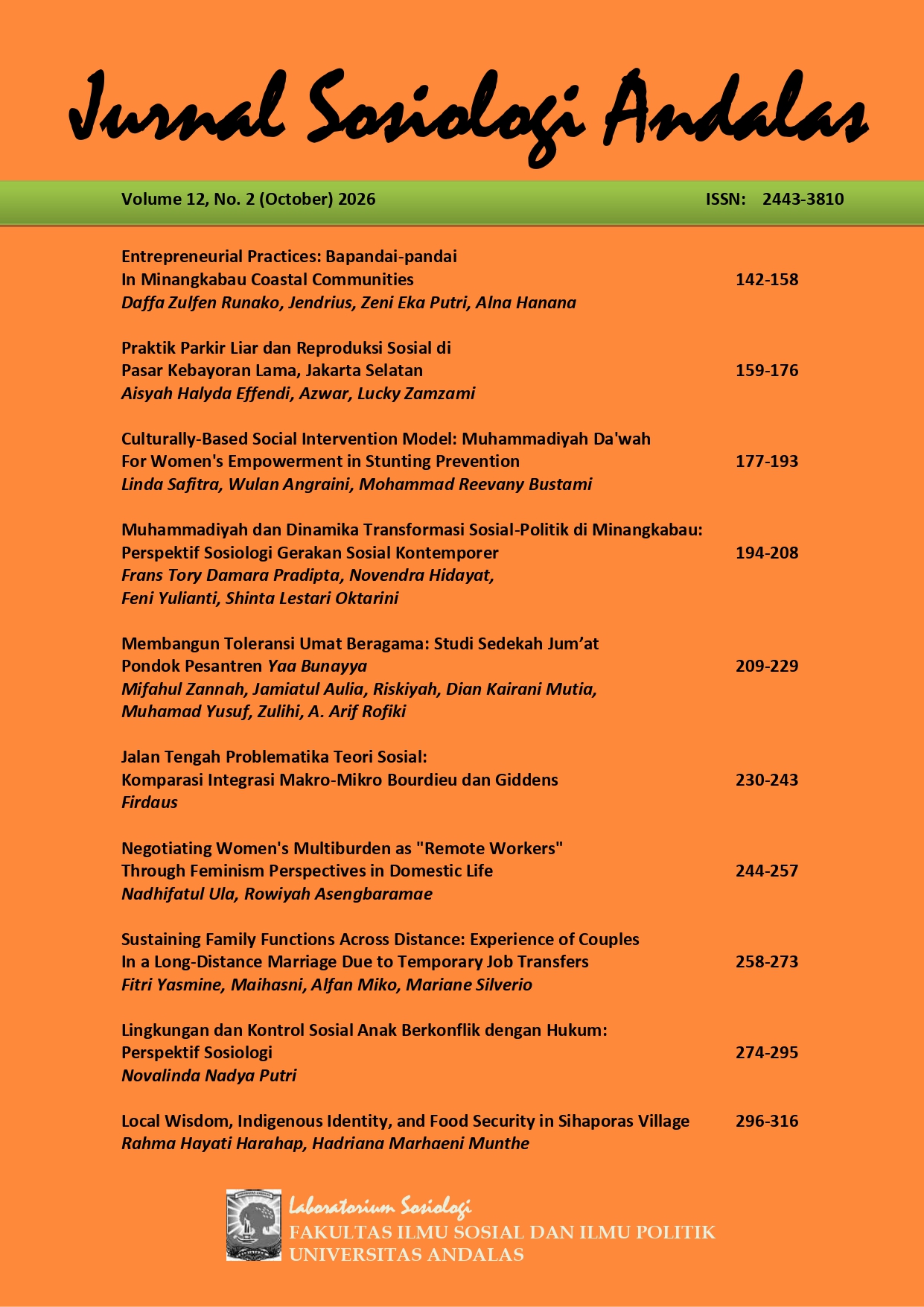
Negotiating Women's Multiburden as "Remote Workers" through Feminism Perspectives in Domestic Life
DOI:
https://doi.org/10.25077/jsa.12.2.244-257.2026Keywords:
Women’s Multiburden, Remote Workers, Gender Identity Negotiation, Gender PerformativityAbstract
Remote work is often promoted as a flexible arrangement that provides more flexibility to allow women to manage their paid employment and domestic duties, previous research has neglected the way this flexibility creates burdens and affects the construction of the gender identity of women. This study explores women’s experience of their double identity as remote workers and how they negotiate their gender identity in a family setting. In order to address the research question, this research takes a qualitative research design that uses interviews with five purposely chosen respondents consisting of married women, mothers, and childless women who have worked remotely for at least a year. The findings show that remote work does not reduce women’s burden; instead, it intensifies it by blurring the boundaries between professional and domestic spheres, leading to increased time pressure and emotional strain. Women negotiate their gender identities through everyday strategies such as time management, emotional regulation, and reliance on spousal and family support. This research contributes to a critical understanding of gender and remote work by challenging the dominant assumption that flexibility leads to women’s empowerment. Instead, it shows how telecommuting can be a vehicle for perpetuating gender inequalities whereby flexibility aggravates the multiple burdens of women from negotiating both the domestic and work aspects. Using Judith Butler’s notion of gender performativity, this study exposes how these gender inequalities persist through everyday practices.
References
Aliffia, D., Mawadah, M., Adawiyah, R., Na’imah, K., Komalasari, S., & Hermina, C. (2022). Konflik Peran Ganda Wanita Karir Saat Work From Home di Masa Pandemi Covid-19. Muadalah, 10(2), 79–88. https://doi.org/10.18592/muadalah.v10i2.7450.
Butler, J. (1988). Performative Acts and Gender Constitution: An Essay in Phenomenology and Feminist Theory. Theatre Journal, 40(4), 519–531.
Elanda, Y. (2020). Konstruksi Ibu Ideal Di Tengah Pandemi Covid 19. Humanisma: Journal of Gender Studies, 10.
Elfira, M., Wibawarta, B., Esther, R., & Febriand, F. (2021). Working from Home: Women Between Public and Domestic Spheres After the Outbreak of COVID-19. International Review of Humanities Studies, 6(1), 5–11.
Garcia, R., & Tomlinson, J. (2021). Rethinking the domestic division of labour: Exploring change and continuity in the context of redundancy. Sociology, 55(2), 300–318. https://doi.org/10.1177/0038038520947311.
Harmanda, Y. L., & Sari, R. M. (2024). Peran Ganda Perempuan Karier. Journal of Science and Social Research, 7(3), 939–946.
Inayah, Z. R., & Fauzi, A. M. (2024). Pembebasan Seksualitas Dan Gender Dalam Film The Danish Girl. Paradigma, 13(1), 131–140.
Kite, M. (2001). Gender Stereotype. In J. Worell (Ed.), Encyclopedia of Women and Gender (hal. 561–570). Academic Press.
Lin, Y., & Li, J. (2025). Association Patterns of Work-Family Balance. Archives of Public Health, 83(1). https://doi.org/10.1186/s13690-025-01631-2.
Ma, J., Xu, L., & Zhang, X. (2025). Work–Family Conflict, Overwork and Mental Health. Frontiers in Public Health, 13. https://doi.org/10.3389/fpubh.2025.1483746.
Mendonca, A., Redkar, A., & Ranganathan, T. (2023). Negotiating Working Motherhood. Women’s Studies International Forum, 99. https://doi.org/10.1016/j.wsif.2023.102793.
Rais, L., Ramli, U., Pattisahusiwa, F., Hidaya, N., & Maqfirah, A. (2025). Religiusitas, konflik gender, dan pencegahan kekerasan terhadap perempuan dan anak di Kota Sorong. JSA: Jurnal Sosiologi Andalas, 11(1), 1–20. https://doi.org/10.25077/jsa.11.1.1-20.2025.
Reza, V., Ardiansyah, M. F., Khovivah, S. N., & Camila, L. A. (2024). Implikasi Budaya Patriarki dalam Keluarga. Jurnal Sosial Politik Humaniora, 1(3).
Riwinda, A. D., & Perdhana, M. S. (2022). Studi literatur mengenai peran ganda pada pekerja perempuan. Diponegoro Journal of Management, 11(4).
Savitri, D. D., & Sigiro, A. N. (2021). Menilai Bekerja dari Rumah. Jurnal Perempuan, 26(1), 39–48.
Stefanova, V., Farrell, L., & Latu, I. (2023). Gender and the Pandemic. Current Psychology, 42(20), 17395–17411. https://doi.org/10.1007/s12144-021-02630-6.
Walby, S. (1989). Theorising Patriarchy. Sociology, 23(2), 213–234.
Widiyanti, R., Wuryaningsih, T., & Lestari, S. (2023). Kampanye media berperspektif gender dalam upaya pencegahan kekerasan seksual pada Instagram Satgas PPKS. JSA: Jurnal Sosiologi Andalas, 9(2), 194–211. https://doi.org/10.25077/jsa.9.2.194-211.2023.
Widyasari, A., & Suyanto. (2023). Pembagian Kerja dalam Rumah Tangga. Endogami: Jurnal Ilmiah Kajian Antropologi, 6(2), 1–12.
Wijanarko, M. F., Madaniyyah, F., & MpD. (2025). Analisis Performativitas Gender Representasi Wanita Independen Modern. 6(2), 388–396.
Yucel, D., & Chung, H. (2021). Working from home, work–family conflict. Community, Work & Family, 26(2), 190–221. https://doi.org/10.1080/13668803.2021.1993138.
Zagefka, H., Houston, D., Duff, L., & Moftizadeh, N. (2021). Combining Motherhood and Work. Journal of Child and Family Studies, 30(10), 2452–2460. https://doi.org/10.1007/s10826-021-02070-7.
Downloads
Published
How to Cite
Issue
Section
License
Copyright (c) 2026 Nadhifatul Ula, Rowiyah Asengbaramae

This work is licensed under a Creative Commons Attribution-NonCommercial-ShareAlike 4.0 International License.