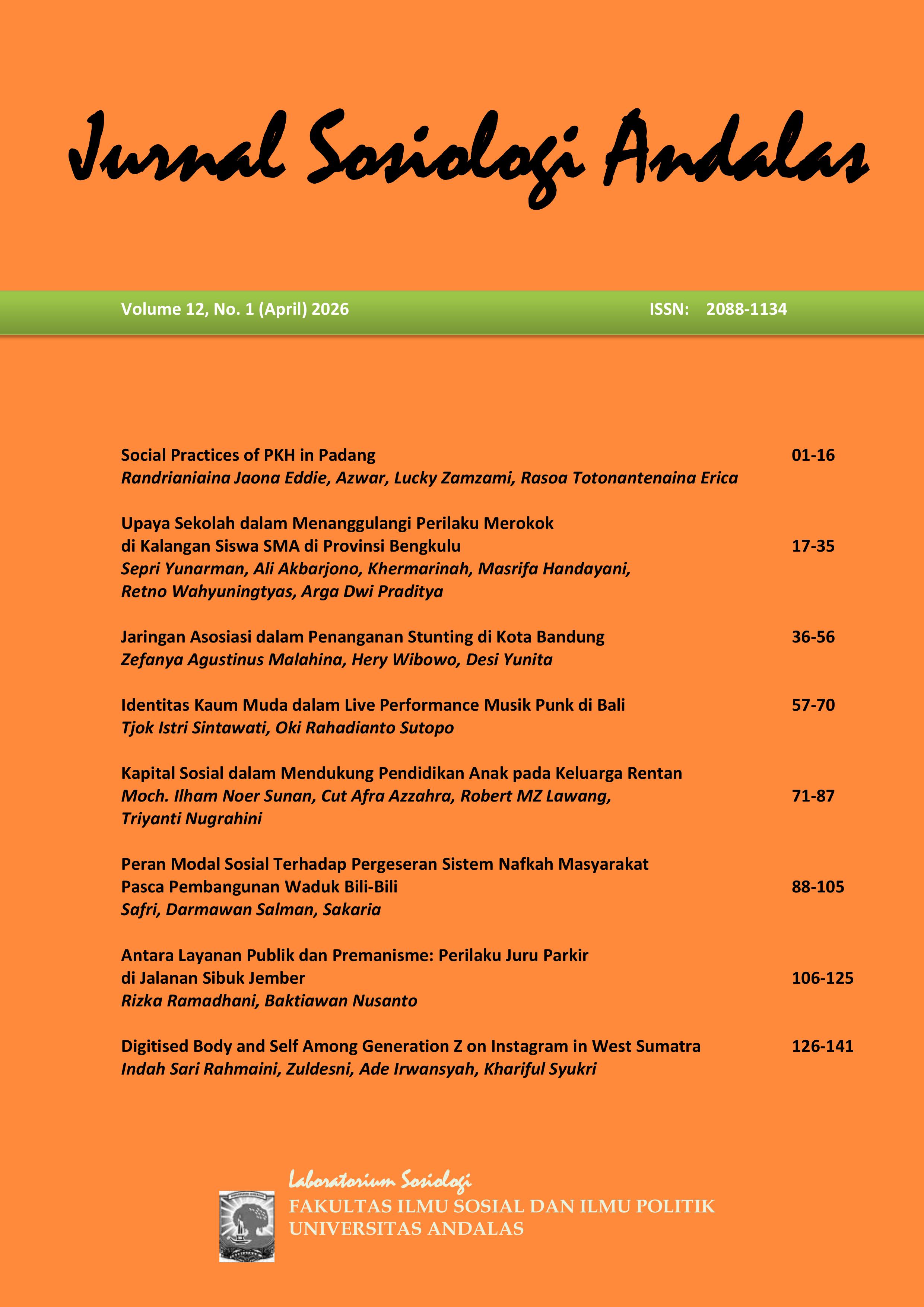
Jaringan Asosiasi dalam Penanganan Stunting di Kota Bandung
DOI:
https://doi.org/10.25077/jsa.12.1.36-56.2026Keywords:
Stunting, Institutional Networks, Collaboration, Network Governance, Bandung CityAbstract
In Bandung City, stunting prevalence declined from 28.12% in 2019 to 12.4% in 2024 alongside improvements in nutrition surveillance and community outreach. This study examines how institutional networks shape stunting governance at the local level. Using a qualitative approach, data were collected through semi-structured interviews with government officials, health center staff, and community cadres, complemented by non-participant observations of coordination meetings and social network analysis of inter-institutional interactions. The findings indicate that strong ties among core government actors—Bappelitbang, the Health Office, and the Population and Family Planning Office—support stable coordination and consistent program implementation. Meanwhile, weak ties with external actors, including universities, religious organizations, and private sector partners, contribute additional resources and ideas, although engagement remains uneven. Health centers and community cadres function as bridging actors that translate policy into community-level action, particularly in early detection and nutrition education. The Task Force for Stunting Acceleration (TPPS) provides a formal platform that structures cross-sector collaboration. Overall, the study highlights the importance of balanced institutional linkages in enabling coordinated stunting interventions while acknowledging ongoing challenges related to capacity disparities and sectoral boundaries.
References
Aisyah, D. N., Mayadewi, C. A., Utami, A., Rahman, F. M., Adriani, N. H., Al Farozi, E., Sayoko, M. H., Chairunisa, A., Restiana, L., Manikam, L., & Kozlakidis, Z. (2025). Using WhatsApp for Nutrition Surveillance Among Children Under 5 Years in West Java, Indonesia: Cross-Sectional Survey and Feasibility Study. JMIR Pediatrics and Parenting, 8, e58752–e58752. https://doi.org/10.2196/58752.
Alam, M. A., Richard, S. A., Fahim, S. M., Mahfuz, M., Nahar, B., Das, S., Shrestha, B., Koshy, B., Mduma, E., Seidman, J. C., Murray-Kolb, L. E., Caulfield, L. E., Lima, A. A. M., Bessong, P., & Ahmed, T. (2020). Correction: Impact of early-onset persistent stunting on cognitive development at 5 years of age: Results from a multi-country cohort study. PLOS ONE, 15(2), e0229663. https://doi.org/10.1371/journal.pone.0229663.
Bustos, M., Lau, L., Manguerra, H., & Dodd, W. (2025). Sociodemographic factors associated with concurrent stunting and wasting among children experiencing extreme poverty in the Philippines: A cross-sectional study. Nutrition and Health, 31(2), 585–596. https://doi.org/10.1177/02601060231203422.
Cai, Y., & Abouzahra, M. (2023). The influence of strong and weak ties in physician peer networks on new drug adoption. International Journal of Health Economics and Management, 23(1), 133–147. https://doi.org/10.1007/s10754-022-09335-8.
Castro-Bedriñana, J., Chirinos-Peinado, D., & Ríos, E. R. (2020). Socioeconomic and Productive Disparity in Child Stunting in the Central Andes of Peru, Taking as a Model the Community of Tunanmarca, Jauja. Advances in Science, Technology and Engineering Systems Journal, 5(3), 135–141. https://doi.org/10.25046/aj050318.
Cockerham, W. C. (2014). Medical Sociology. In The Wiley Blackwell Encyclopedia of Health, Illness, Behavior, and Society (pp. 1–19). Wiley. https://doi.org/10.1002/9781118410868.wbehibs548.
Creswell, J. W., & Creswell, J. D. (2022). Research Design: Qualitative, Quantitative, and Mixed Methods Approaches. SAGE Publications.
Damayanti, R., Nugroho, A. B., Triarda, R., & Sari, I. P. (2021). Peleburan ego sektoral: strategi menurunkan stunting di Trenggalek. Jurnal Administrasi Dan Kebijakan Publik, 6(2), 197–216. https://doi.org/10.25077/jakp.6.2.197-216.2021.
Damsar, P. D. (2016). Pengantar Sosiologi Ekonomi. Kencana.
Darmawati, Dimiati, H., Fitri, A., Rizkia, M., Kiftia, M., Saffanah, N., Halifah, E., & Sufriani. (2024). The Characteristics of Pregnant Women in Preventing Anemia and Stunting in Aceh Besar Regency, Indonesia. Journal of Liaquat University of Medical & Health Sciences, 23(1), 12–18. https://doi.org/10.22442/jlumhs.2024.01119.
Deshpande, A., & Khanna, S. (2021). Can weak ties create social capital? Evidence from Self-Help Groups in rural India. World Development, 146, 105534. https://doi.org/10.1016/j.worlddev.2021.105534.
Dinkes Jawa Barat. (2021). Profil Kesehatan Jawa Barat 2020.
Dinkes Kota Bandung. (2025). Profil Kesehatan Kota Bandung 2024.
Diskominfo Kota Bandung. (2023). Pemkot Bandung Gulirkan Berbagai Program Cegah Stunting Baru. Humas Kota Bandung. https://www.bandung.go.id/news/read/8216/pemkot-bandung-gulirkan-berbagai-program-cegah-stunting-baru.
Fronczak, A., Mrowinski, M. J., & Fronczak, P. (2022). Scientific success from the perspective of the strength of weak ties. Scientific Reports, 12(1), 5074. https://doi.org/10.1038/s41598-022-09118-8.
Granovetter, M. S. (1973). The Strength of Weak Ties. American Journal of Sociology, 78(6), 1360–1380. https://www.jstor.org/stable/2776392.
Granovetter, M. S. (1974). Getting a Job: A study of contacts and careers. Harvard University Press.
Granovetter, M. S. (1985). Economic Action and Social Structure: The Problem of Embeddedness. American Journal of Sociology, 91(3), 481–510. https://www.jstor.org/stable/2780199.
Hamdi, H., Moh Nazar Fajri, Rohani Inta Dewi, & M. Adib Zata Ilmam. (2023). Analisis Kebijakan Stunting Menggunakan Pendekatan Systematic Literature Review (SLR). Jurnal Cahaya Mandalika, 4(3), 1239–1246. https://doi.org/10.36312/jcm.v4i3.2067.
Hermawan, M. F., Yudha, E. P., Kusno, K., & Nugraha, A. (2023). Konvergensi Aktor Kelembagaan Dalam Penanganan Stunting Di Kabupaten Sumedang. Mimbar Agribisnis : Jurnal Pemikiran Masyarakat Ilmiah Berwawasan Agribisnis, 9(1), 727. https://doi.org/10.25157/ma.v9i1.8968.
Irwanto, R. R. (2024). Kapabilitas dan Relasi Antar Aktor Pemerintah Dalam Penanganan Stunting: Studi di Kabupaten Gunungkidul. Sosio Konsepsia, 13(2). https://doi.org/10.33007/ska.v13i2.3287.
Kemenkes RI. (2016). Situasi Balita Pendek. In Pusat Data dan Informasi Kemenkes RI.
Kemenkes RI. (2018). Buletin Stunting. Kementerian Kesehatan RI, 301(5), 1163–1178.
Kemenkes RI. (2025). SSGI 2024 dalam Angka. https://www.badankebijakan.kemkes.go.id/survei-status-gizi-indonesia-ssgi-2024/.
Kementerian Kesehatan. (2025). SISDMK - Sistem Informasi Sumber Daya Manusia Kesehatan. https://sisdmk.kemkes.go.id.
Kementerian PPN/Bappenas. (2025). Rencana Pembangunan Jangka Menengah 2025-2029.
Klärner, A., Gamper, M., Keim-Klärner, S., Moor, I., von der Lippe, H., Richter, M., & Vonneilich, N. (2022). Social Networks and Health Inequalities. In A. Klärner, M. Gamper, S. Keim-Klärner, I. Moor, H. von der Lippe, & N. Vonneilich (Eds.), Social Networks and Health Inequalities: A New Perspective for Research. Springer International Publishing. https://doi.org/10.1007/978-3-030-97722-1.
Korn, A. R., Cruz, J. L., Smith, N. R., Jacob, R. R., Carney, M., Slater, W., & Ramanadhan, S. (2024). Advancing and strengthening the study of social networks in community-level dissemination and implementation research: A narrative review. Journal of Clinical and Translational Science, 8(1), e203. https://doi.org/10.1017/cts.2024.614.
Kustanto, D. R., Ramadhanti, I. P., & Tanjung, A. (2025). Stunting dan Kemiskinan. Jurnal Pengabdian Masyarakat Aufa (JPMA), 7(2). https://doi.org/10.51933/jpma.v7i2.2032.
Lainua, M. Y. W. (2016). Faktor-faktor yang Mempengaruhi Balita Stunting di Kelurahan Sidorejo Kidul salatiga [Program Studi Ilmu Keperawatan FIK-UKSW]. https://repository.uksw.edu/handle/123456789/11772.
Lam, J., Broccatelli, C., & Baxter, J. (2023). Diversity of strong and weak ties and loneliness in older adults. Journal of Aging Studies, 64, 101097. https://doi.org/10.1016/j.jaging.2022.101097.
Marmot, M. (2005). Social determinants of health inequalities. The Lancet, 365(9464), 1099–1104. https://doi.org/10.1016/S0140-6736(05)71146-6.
Nowell, B., & Steelman, T. (2025). The weakness of weak ties: do social capital investments among leaders pay off during times of disaster? Journal of Public Administration Research and Theory, 35(2), 180–198. https://doi.org/10.1093/jopart/muaf002.
Nurva, L., & Maharani, C. (2023). Analisis Pelaksanaan Kebijakan Penanggulangan Stunting: Studi Kasus di Kabupaten Brebes. Jurnal Kebijakan Kesehatan Indonesia, 12(2), 74. https://doi.org/10.22146/jkki.81342.
Pan, X., & Chee, K. H. (2020). The power of weak ties in preserving cognitive function: a longitudinal study of older Chinese adults. Aging & Mental Health, 24(7), 1046–1053. https://doi.org/10.1080/13607863.2019.1597015.
Patton, M. Q. (2015). Qualitative Research & Evaluation Methods: Integrating Theory and Practice. Sage Publications.
Picauly, I., Agung Ayu Mirah Adi, A., Meiyetriani, E., Mading, M., Weraman, P., Fadhilatun Nashriyah, S., Thohir Hidayat, A., L. Adeline Boeky, D., Lobo, V., S. Saleh, A., & A Peni, J. (2022). Factors Influencing the Role of Religious Leaders in the Process Accelerate Stunting Response in East Nusa Tenggara Province. Journal of Maternal and Child Health, 7(6), 618–629. https://doi.org/10.26911/thejmch.2022.07.06.01.
Pratama, Y. F., Sekarningrum, B., & Yunita, D. (2024). Modal Sosial Masyarakat dalam Mengatasi Limbah Minyak Jelantah melalui Program Tersenyum. Jurnal Sosiologi Andalas, 10(1), 56–70. https://doi.org/10.25077/jsa.10.1.56-70.2024.
Ritzer, G. (2015). Teori Sosiologi Modern Ed.7 (7th ed.). Kencana.
Suwandono, T. A. (2023). Pelaksanaan Konvergensi Percepatan Penurunan Stunting di Kota Bandung. Konferensi Nasional Ilmu Administrasi, 7(1), 283–289. https://knia.stialanbandung.ac.id/index.php/knia/article/view/895.
Taylor, M., Tapkigen, J., Ali, I., Liu, Q., Long, Q., & Nabwera, H. (2023). The impact of growth monitoring and promotion on health indicators in children under five years of age in low- and middle-income countries. The Cochrane Database of Systematic Reviews, 10(10), CD014785. https://doi.org/10.1002/14651858.CD014785.pub2.
UNICEF, & Kementerian PPN/Bappenas. (2024). Formative Evaluation of the National Strategy to Accelerate Stunting Prevention.
UNICEF, WHO, & World Bank. (2025). Levels and trends in child malnutrition: Key finding of the 2025 edition. https://iris.who.int/server/api/core/bitstreams/a0aad785-4ff8-43d7-bdf9-be6c9a221e8e/content.
Wellman, B. (1983). Network Analysis: Some Basic Principles. Sociological Theory, 1, 155. https://doi.org/10.2307/202050.
WHO. (2019). Essential nutrition actions: mainstreaming nutrition through the life-course. World Health Organization. https://iris.who.int/bitstream/handle/10665/326261/9789241515856-eng.pdf.
Wulansari, I. (2022). Jaringan Bonding Kapital Sosial Petani Melestarikan Mekanisme Adaptasi Kolektif Petani. Jurnal Sosiologi Andalas, 8(2), 98–114. https://doi.org/10.25077/jsa.8.2.98-114.2022.
Yousefi-Nooraie, R., Dobbins, M., Marin, A., Hanneman, R., & Lohfeld, L. (2015). The evolution of social networks through the implementation of evidence-informed decision-making interventions: a longitudinal analysis of three public health units in Canada. Implementation Science, 10(1), 166. https://doi.org/10.1186/s13012-015-0355-5.
Yuda, A., Septina, Z., Maharani, A., & Nurdiantami, Y. (2023). Tinjauan Literatur : Perkembangan Program Penanggulangan Stunting di Indonesia. Jurnal Epidemiologi Kesehatan Indonesia, 6(2). https://doi.org/10.7454/epidkes.v6i2.6049.
Downloads
Published
How to Cite
Issue
Section
License
Copyright (c) 2026 Zefanya Agustinus Malahina, Hery Wibowo, Desi Yunita

This work is licensed under a Creative Commons Attribution-NonCommercial-ShareAlike 4.0 International License.