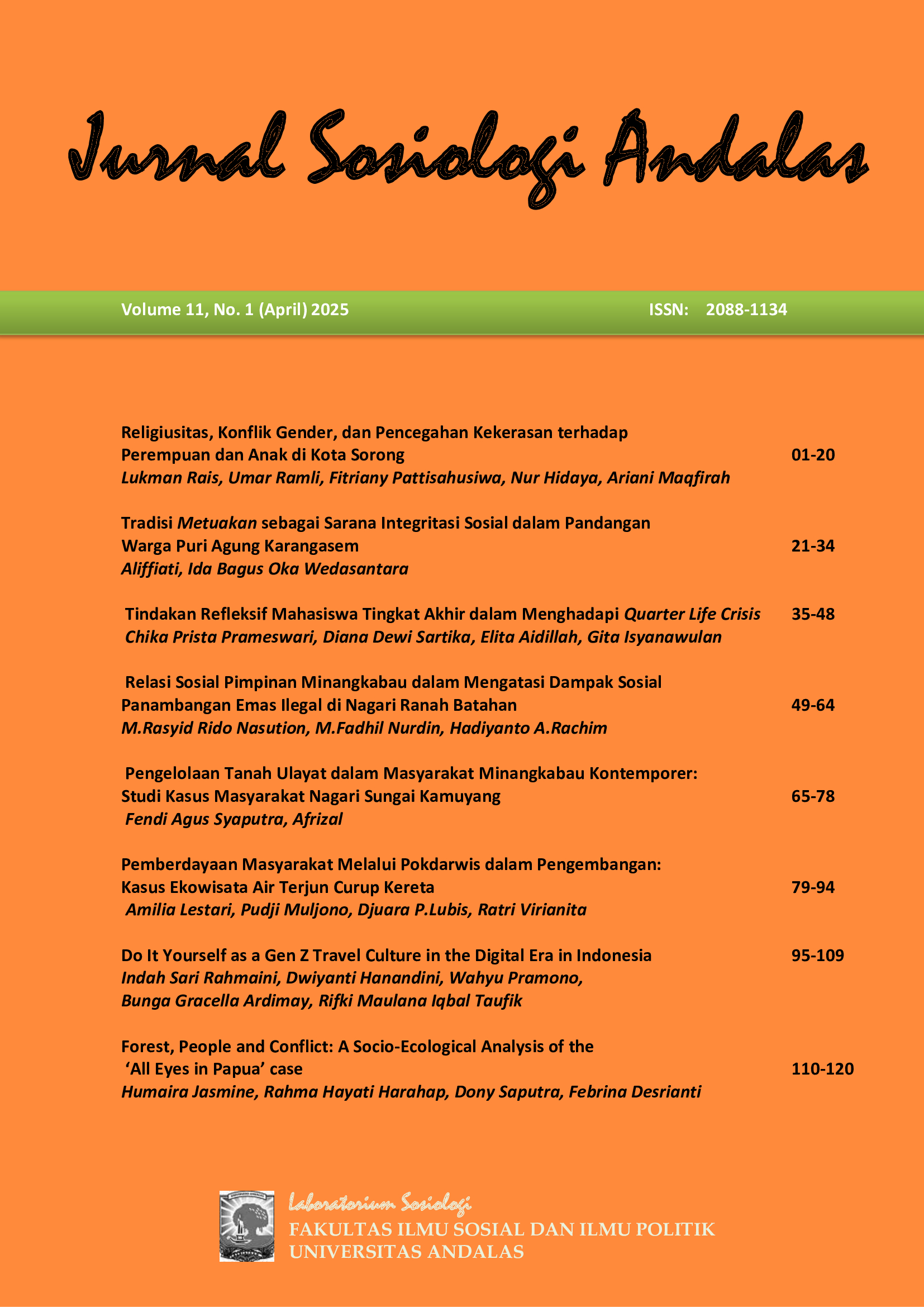
Religiusitas, Konflik Gender, dan Pencegahan Kekerasan terhadap Perempuan dan Anak di Kota Sorong
DOI:
https://doi.org/10.25077/jsa.11.1.1-20.2025Keywords:
Religiosity, Gender Conflict, Violent Behavior, Role of Religion, Protection of Women and ChildrenAbstract
The purpose of this study is to examine (1) how religious groups can help to avoid violent conduct, (2) how religion and violence are related, and (3) how gender conflict and violent behavior are related. In Sorong City, Southwest Papua, this study employs a quantitative methodology using a correlational design and probability sampling approaches. Cluster random sampling was used to determine the sample. Gathering information via surveys, literature reviews, and observation combined with descriptive and inferential statistical analysis. The results of the study found that religious institutions play a role in preventing violence against women and children through teaching-based education that emphasizes protection and peace. The hypothesis test results showed that religiosity did not significantly affect violent behavior (tcount -0.459 < ttable 1.960; significance 0.647 > 0.05). On the other hand, when combined with gender conflict, religiosity showed a significant effect (fcount 616.697 > fttable 3.04; significance 0.001 < 0.05). This study also revealed that gender conflict was positively and significantly related to violent behavior (tcount 31.665 > ttable 1.960; significance 0.000 < 0.05), indicating that gender inequality and gender role stereotypes exacerbate violence.
References
Ahmadi, R., & Siswanto, S. (2023). Pengaruh Service Quality dan Tingkat Religiusitas terhadap Minat Menabung di Bank Syariah Indonesia. Ekonomis: Journal of Economics and Business, 7(1), 164. https://doi.org/10.33087/ekonomis.v7i1.773
Al Ghozali, C. M., & Astuti, S. W. (2024). Pengaruh Konflik Gender terhadap Perilaku Mencari Bantuan dengan Stigma Diri sebagai Variabel Mediasi. Jurnal Social Library, 4(2), 324–331. https://doi.org/https://doi.org/10.51849/sl.v4i2.257
Ali, M., Rais, L., Gafur, M. A. A., Ponisri, Sukmawati, Rosalina, F., & Riskawati. (2023). Mitigasi Dampak Kekerasan terhadap Perempuan dan Anak di Distrik Sorong Kepulauan Kota Sorong. ENTITA: Jurnal Pendidikan Ilmu Pengetahuan Sosial Dan Ilmu-Ilmu Sosial, 5(2), 215–234. https://doi.org/10.19105/ejpis.v5i2.10409
Aprilia, V., & Masyhadi, A. K. (2022). Pengaruh religiositas dan sikap peran gender sexism terhadap kecenderungan perilaku kekerasan oleh suami. Jurnal Psikologi Ulayat, 10(1), 96–113. https://doi.org/10.24854/jpu440
Astuti, D. (2023). Relasi Kuasa Dalam Kekerasan Berbasis Gender: Diskusi Bersama Satgas SIGRAK Kota Yogyakarta. Jurnal Ilmiah Padma Sri Kreshna, 10–15. https://ejournal.widyamataram.ac.id.prosiding-uwm.com/index.php/padma/article/view/1050%0Ahttps://ejournal.widyamataram.ac.id.prosiding-uwm.com/index.php/padma/article/view/1050/514
Baharuddin, J. (2021). Pengaruh Religiusitas dan Perilaku Terencana Terhadap Minat Menggunakan Cashless Pada Masyarakat Kota Jayapura di masa Covid-19. Jurnal Ilmiah Ekonomi Islam, 7(3), 1306–1312. https://jurnal.stie-aas.ac.id/index.php/jei/article/view/3353
BPS Indonesia. (2023). Indeks Ketimpangan Gender 2023. In Indeks Ketimpangan Gender 2022. Badan Pusat Statistik.
Creswell, J. W. (2019). Research Design: Qualitative, Quantitative and Mixed Approaches. In Edisi III (Ed.), Pustaka Pelajar. Pustaka Pelajar.
Erni, E., & Asror, M. A. K. (2022). Degradasi Moral Di Kalangan Pemuka Agama. Jurnal Pendidikan Sosiologi Dan Humaniora, 13(2), 237–243. https://doi.org/10.26418/j-psh.v13i2.54004
Fitri Pebriaisyah, B., Wilodati, W., & Komariah, S. (2022). Kekerasan Seksual di Lembaga Pendidikan Keagamaan: Relasi Kuasa Kyai Terhadap Santri Perempuan di Pesantren. Sosietas : Jurnal Pendidikan Sosiologi, 12(1), 1–14. https://doi.org/10.17509/sosietas.v12i1.48063
Ghaliyan Ibnunas, B., & Harjawati, T. (2021). Pengaruh Religiusitas Terhadap Minat Pembelian Produk Halal. Jurnal Ilmiah Mahasiswa (JIMAWA), 1(2), 117–125. https://doi.org/10.32493/jmw.v1i2.10105
Ghozali, I. (2019). Qualitative and Quantitative Research Design. Universitas Diponegoro.
Hasbi, M. (2017). Kekerasan Terhadap Perempuan Menurut Tinjauan Agama Dan Sosiologi. Al-MAIYYAH : Media Transformasi Gender Dalam Paradigma Sosial Keagamaan, 10(2), 263–277. https://doi.org/10.35905/almaiyyah.v10i2.506
Hasibuan, K. (2023). Moderasi Beragama Berbasis Keluarga. SENTRI: Jurnal Riset Ilmiah, 2(11), 4655–4666. https://doi.org/10.55681/sentri.v2i11.1777
Hazin, M., Rahmawati, N. W. D., & Shobri, M. (2021). Hak Asasi Manusia Dalam Perspektif Islam Dan Maqashid Al-Syari’Ah. CENDEKIA: Jurnal Studi Keislaman, 7(1), 101–114. https://doi.org/10.37348/cendekia.v7i1.123
Kalifah, D. R. N., Hidayah, N., Shawmi, A. N., & ... (2022). Penguatan Pendidikan Karakter dalam Keluarga sebagai Penangguhan Kejahatan Seksual Bagi Perempuan. Prosiding Konferensi Nasional Gender Dan Gerakan Sosial, 01(01), 900–912. https://103.84.119.236/index.php/kggs/article/view/294%0Ahttps://103.84.119.236/index.php/kggs/article/download/294/368
Kementerian PPA. (2025). Sistem Informasi Online Perlindungan Perempuan dan Anak (SIMFONI PPA). Kementerian PPA. https://kekerasan.kemenpppa.go.id/
Khumas, A., Prawitasari, J. E., & Retnowati, S. (2015). Model Penjelasan Intensi Cerai Perempuan Muslim di Sulawesi Selatan. Jurnal Psikologi, 42(3), 189. https://doi.org/10.22146/jpsi.9908
Koc, F., Ozkan, B., Komodromos, M., Halil Efendioglu, I., & Baran, T. (2024). The effects of trust and religiosity on halal products purchase intention: indirect effect of attitude. EuroMed Journal of Business, 20(5), 141–165. https://doi.org/10.1108/EMJB-01-2024-0004
Laing, H. (2023). Kekerasan Perempuan dan Anak di Kota Sorong 91 Kasus. RRI Sorong. https://www.rri.co.id/daerah/367689/kekerasan-perempuan-dan-anak-di-kota-sorong-91-kasus?utm_source=popular_home&utm_medium=internal_link&utm_campaign=General Campaign
Mardliyah, U., Rais, L., & Rumodar, R. (2024). Strengthening the Protection for Women and Children from Violence ( Collaboration between Aisyiyah and Nasyiatul Aisyiyah in Sorong ) Memperkuat Perlindungan Perempuan dan Anak dari Kekerasan ( Kolaborasi Aisyiyah dan Nasyiatul Aisyiyah di Kota Sorong ). Jurnal Perempuan Dan Anak (JPA), 7(2), 71–84. https://doi.org/10.22219/jpa.v7i2.33969
Maulida, H. (2021). Perempuan dalam Kajian Sosiologi Gender: Konstruksi Peran Sosial, Ruang Publik, dan Teori Feminis. Journal of Politics and Democracy, 1(1), 71–79. https://doi.org/10.61183/polikrasi.v1i1.6
Munasaroh, A. (2022). Problematika Kekerasan Berbasis Gender Dan Pencapaian Gender Equality Dalam Sustainable Development Goals Di Indonesia. IJouGS: Indonesian Journal of Gender Studies, 3(1), 1–20. https://doi.org/10.21154/ijougs.v3i1.3524
Nafi’ah, H., & Arham, A. B. (2024). Pengaruh Religiusitas terhadap Kebahagiaan pada Mahasiswa Institut Agama Islam Tribakti Kota Kediri. Journal of Theory and Practice in Islamic Guidance and Counseling, 1(1), 51–63. https://doi.org/10.33367/jtpigc.v1i1.5678
Ou, C., Yasmin, M., Ussatayeva, G., Lee, M., & Dalal, K. (2021). Prevalence of intimate partner violence against women in Republic of Benin. African Journal of Reproductive Health, 25(August), 63–75. https://doi.org/10.29063/ajrh2021/v25i4.7
Putri, A., Amanda, D., Yanti, R. F., Amin, A., & Batubara, A. K. (2023). Hak Asasi Manusia Dalam Perspektif Islam. Al-Wasathiyah: Journal of Islamic Studies, 2(2), 195–208. https://doi.org/10.56672/alwasathiyah.v2i2.75
Rahmadhani, G. A., & Virianita, R. (2020). Pengaruh Stereotip Gender dan Konflik Peran Gender Laki-laki terhadap Motivasi Kerja Pemuda Desa Putus Sekolah. Jurnal Sains Komunikasi Dan Pengembangan Masyarakat [JSKPM], 4(2), 217–234. https://doi.org/10.29244/jskpm.4.2.217-234
Rigual, C., Prügl, E., & Kunz, R. (2022). Gender and the micro-dynamics of violent conflicts. International Feminist Journal of Politics, 24(3), 345–367. https://doi.org/10.1080/14616742.2022.2083652
Ritzer, G. (2015). Teori Sosiologi Modern : Edisi 7 (7th ed.). Kencana Pradana Media Grup.
Ritzer, G. (2019). Sosiologi ilmu pengetahuan berparadigma ganda (Alimandan (ed.); 3rd ed.). PT Raja Grafindo.
Rusmawati, P., Jendrius, & Maihasni. (2023). Perempuan Dalam Dominasi Maskulin : Studi Pola Relasi Mahasiswa Perempuan Dengan Dosen dan Mahasiswa Laki-Laki. JSA : Jurnal Sosiologi Andalas, 9(1), 79–94. https://doi.org/https://doi.org/10.25077/jsa.9.1.63-78.2023
Safwan. (2023). Komnas Perempuan Soroti Kasus Kekerasan Anak dan Perempuan Tinggi di Sorong, Ini Jumlah Terakhir. Tribun Sorong. https://sorong.tribunnews.com/2023/06/01/komnas-perempuan-soroti-kasus-kekerasan-anak-dan-perempuan-tinggi-di-sorong-ini-jumlah-terakhir
Sekaran, U., & Bougie, R. (2017). Metode Penelitian untuk Bisnis: Pendekatan Pengembangan-Keahlian (6th ed.). Salemba Empat.
Sikweyiya, Y., Addo-Lartey, A. A., Alangea, D. O., Dako-Gyeke, P., Chirwa, E. D., Coker-Appiah, D., Adanu, R. M. K., & Jewkes, R. (2020). El patriarcado y las actitudes desiguales de género como impulsores de la violencia de pareja contra las mujeres en la región central de Ghana. BMC Public Health, 20(1), 1–11. https://doi.org/https://doi.org/10.1186/s12889-020-08825-z
Silviana, I. (2021). Religiusitas Sebagai Modal Sosial Mahasiswa E-Preneur Prodi Sosiologi Agama Iain Kediri. Jurnal Sosiologi Reflektif, 15(2), 380–405. https://doi.org/10.14421/jsr.v15i2.2130
Siregar, D. S. (2023). Fenomena Kekerasan Berbasis Gender Terhadap Perempuan. Yurispruden: Jurnal Fakultas Hukum Universitas Islam Malang, 7(1), 40–58. https://doi.org/10.33474/yur.v7i1.19593
Soleman, N. (2020). Analisis Perbandingan Hukum Islam dan Undang Undang KDRT Tentang Kekerasan Dalam Rumah Tangga. Al-Wardah: Jurnal Kajian Perempuan, Gender Dan Agama, 14(2), 275–284. https://doi.org/10.46339
Sugiyono. (2020). Metode Penelitian Kuantitatif Kualitatif dan R&D. Alfabeta.
Valente, R. R., & Smith, R. A. (2023). Religiosity and Misanthropy across the Racial and Ethnic Divide. Religions, 14(3), 1–24. https://doi.org/https://doi.org/10.3390/ rel14030393
Wibowo, F. W., & Sujono, R. I. (2021). Pengaruh Religiusitas Terhadap Wirausaha Muslim Muda (Studi Kasus Pondok Pesantren Di Yogyakarta). Al-Infaq: Jurnal Ekonomi Islam, 12(2), 138. https://doi.org/10.32507/ajei.v12i2.867
Wibowo, G. A., Chairuddin, C., Rahman, A., & Riyadi, R. (2022). Kesetaraan Gender: Sebuah Tinjauan Teori Feminisme. SEUNEUBOK LADA: Jurnal Ilmu-Ilmu Sejarah, Sosial, Budaya Dan Kependidikan, 9(2), 121–127. https://doi.org/10.33059/jsnbl.v10i2.6360
Widiyanti, R., Wuryaningsih, T., & Lestari, S. (2023). Kampanye Media Berperspektif Gender dalam Upaya Pencegahan Kekerasan Seksual pada Instagram Satgas PPKS. JSA : Jurnal Sosiologi Andalas, 9(2), 193–210. https://doi.org/https://doi.org/10.25077/jsa.9.2.194-211.2023
Zavala, A. G. De. (2021). Male, National, and Religious Collective Narcissism Predict Sexism. Sex Roles, 84, 680–700. https://doi.org/https://doi.org/10.1007/s11199-020-01193-3
Downloads
Published
How to Cite
Issue
Section
License
Copyright (c) 2025 Lukman Rais, Umar Ramli, Fitriani Pattisahusiwa, Nur Hidaya, Ariani Maqfirah

This work is licensed under a Creative Commons Attribution-NonCommercial-ShareAlike 4.0 International License.