
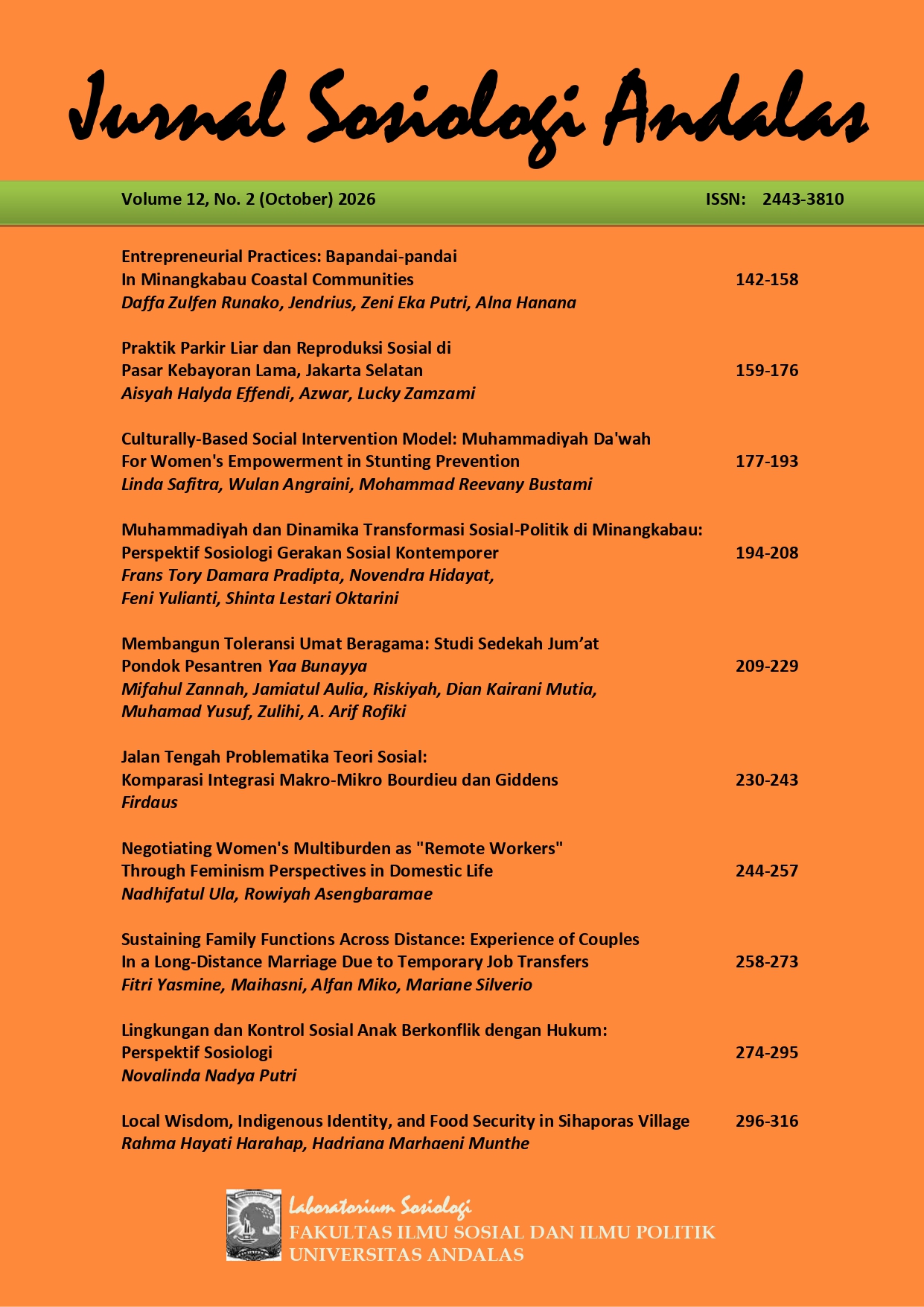
Jalan Tengah Problematika Teori Sosial: Komparasi Integrasi Makro-Mikro Bourdieu dan Giddens
DOI:
https://doi.org/10.25077/jsa.12.2.230-243.2026Keywords:
Bourdieu, Giddens, Habitus, Structuration, Integration of TheoriesAbstract
In the tradition of social theory, there has long been a debate between macro and micro or structure and agent approaches. These debates have tended to be adversarial and to negate each other. Recent decades have seen efforts to try to resolve this theoretical problem by integrating the two. Some scholars have offered integrative ideas to address this theoretical problem. This article aims to explain the thoughts of two prominent figures in the integration of two contrasting approaches, namely Pierre Bourdieu with his habitus theory and Anthony Giddens with his structuration theory. By tracing their writings and discussing their work, this article is based on the results of a literature review. This article shows that Bourdieu, with his habitus theory, has been successful in integrating habitus, field, and capital in the understanding of the social world. Anthony Giddens has successfully integrated structure and agent in understanding the social world. Both use the social practice approach in developing their integration theory. Bourdieu developed a triadic approach, and Giddens a dyadic approach. Both have become a conversation among social scientists and have succeeded in laying the foundations of integrative theory, mediating the debate between the two polar paradigms in social theory.
References
Alexander, J. C. (2008). Sentralitas Karya-karya Klasik. In A. Giddens & J. Turner (Eds.), Social Theory Today: Panduan Sistematis Tradisi dan Tren Terdepan Teori Sosial (pp. 1–84). Yogyakarta: Pustaka Pelajar.
Archer, M. S. (1982). Morphogenesis versus Structuration: On Combining Structure and Action. The British Journal of Sociology, 33(4), 455–483. Retrieved from https://www.jstor.org/stable/589357.
Bouraieu, P. (1984). Distintion: A Social Critique of The Judgement of Taste. Cambridge: Harvard University Press.
Bourdieu, P. (1990). The Logic of Practice. United Kingdom: Polity Press.
Burridge, P., Carpenter, C., Cherednichenko, B., & Kruger, T. (2010). Investigating Praxis Inquiry Within Teacher Education Using Giddens’ Structuration Theory. Journal of Experiential Education, 33(1), 19–37. https://doi.org/10.1177/105382591003300103.
Calhoun, C., Gerteis, J., Moody, J., Pfaff, S., & Virk, I. (2012a). Classical Sociological Theory (Third Ed). United Kingdom: Wiley-Blackwell.
Calhoun, C., Gerteis, J., Moody, J., Pfaff, S., & Virk, I. (2012b). Contemporary Sociological Theory (Third Ed). United Kingdom: Wiley-Blackwell.
Cohen, I. J. (2008). Teori Strukturasi dan Praksis Sosial. In A. Giddens & J. Turner (Eds.), Social Theory Today: Panduan Sistematis Tradisi dan Tren Terdepan Teori Sosial (pp. 471–534). Yogyakarta: Pustaka Pelajar.
Durkheim, E. (1982). The Rules Of Sociological Method. New York: The Free Press.
Fligstein, N. (2001). Social Skill and the Theory of Fields. Sociological Theory, 19(2), 105–125. https://doi.org/10.1111/0735-2751.00132.
Fligstein, N., & McAdam, D. (2012). A Theory of Fields. New York: Oxford University Press.
Fries, C. J. (2009). Bourdieu’s Reflexive Sociology as a Theoretical Basis for Mixed Methods Research: An Application to Complementary and Alternative Medicine. Journal of Mixed Methods Research, 3(4), 326–348. https://doi.org/10.1177/1558689809336660.
Gibson, W. J., & Brown, A. (2009). Working with Qualitative Data. London: SAGE Publications Ltd.
Giddens, A. (1984). The Constitution of Society. United Kingdom: Polity Press.
Giddens, A. (2010). Teori Strukturasi: Dasar-Dasar Pembentukan Struktur Sosial Masyarakat. Yogyakarta: Pustaka Pelajar.
Grenfell, M. (2008a). Biography of Baourdieu. In M. Grenfell (Ed.), Pierre Bourdieu Key Concepts (pp. 11–26). Durham, UK: Acumen Publishing Ltd.
Grenfell, M. (2008b). Pierre Bourdieu: Key Concepts (M. Grenfell, ed.). Durham: Acumen Publishing Ltd.
Ignatow, G. (2020). Sociological Theory in The Digital Age. London & New York: Routledge.
Johnson, D. P. (1994). Teori Sosiologi Klasik dan Modern. Jakarta: PT. Gramedia Pustaka Utama.
Lehmann, W., & Taylor, A. (2015). On the Role of Habitus and Field in Apprenticeships. Work, Employment and Society, 29(4), 607–623. https://doi.org/10.1177/0950017014564616.
Lizardo, O. (2004). The Cognitive Origins of Bourdieu’s Habitus. Journal for the Theory of Social Behaviour, 34(4), 375–401.
Lizardo, O. (2010). Beyond the antinomies of structure: Levi-Strauss , Giddens, Bourdieu, and Sewell. Theory and Society, 39(6), 651–688. https://doi.org/10.1007/s11186-010-9125-1.
Lukes, S. (1975). Emile Durkheim. Harmondsworth: Penguin.
Maton, K. (2008). Habitus. In M. Grenfell (Ed.), Pierre Bourdieu: Key Conceptse (pp. 49–66). Durham: Acumen Publishing Ltd.
Paulle, B., Heerikhuizen, B. Van, & Emirbayer, M. (2012). Elias and Bourdieu. Journal of Classical Sociology, 12(1), 69–93. https://doi.org/10.1177/1468795X11433708.
Ritzer, G. (2008). Classical Sociological Theory (Fifth Ed). New York: McGraw-Hill.
Ritzer, G. (2014). Teori Sosiologi; Dari Sosiologi Klasik Sampai Perkembangan Terakhir Posmodern (12th ed.). Yogyakarta: Pustaka Pelajar.
Robbins, D. (2002). Sociology and Philosophy in the Work of Pierre Bourdieu, 1965–75. Journal of Classical Sociology, 2(3), 299–328.
Schatzki, T. R. (1997). Practices and Actions A Wittgensteinian Critique of Bourdieu and Giddens. Philosophy of the Social Sciences, 27(3), 283–308. https://doi.org/10.1177/004839319702700301.
Stones, R. (2001). Refusing the Realism-Structuration Divide. European Journal of Social Theory, 4(2), 177–197. https://doi.org/10.1177/13684310122225064.
Stones, R. (2005). Structuration Theory (I. Craib & R. Stones, eds.). London: Plgrave Macmillan.
Thomson, P. (2008). Field. In M. Grenfell (Ed.), Pierre Bourdieu Key Concepts (pp. 67–84). Durham, UK: Acumen Publishing Ltd.
Tsekeris, C., & Lydaki, A. (2011). The Micro-Macro Dilemma in Sociology: Perplexities and Perspectives. Sociologija, III(1), 67–82. https://doi.org/10.2298/SOC1101067T.
Waters, M. (2000). Modern Sociological Theory. London: Sage Publication Ltd.
Downloads
Published
How to Cite
Issue
Section
License
Copyright (c) 2026 Firdaus Firdaus

This work is licensed under a Creative Commons Attribution-NonCommercial-ShareAlike 4.0 International License.